

|
|
 |
Articles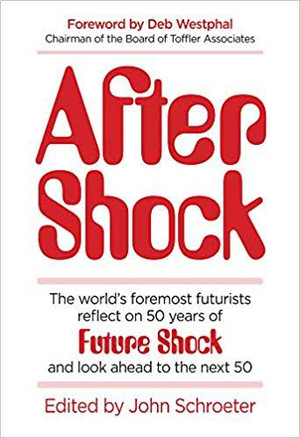
October 18, 2021
ForwardIt isn't hard to be a "futurist." You don't need supernatural powers or special ability to interpret the movement of stars and planets. No need for a crystal ball, tarot cards or lock of your loved one's hair. In truth, there's nothing particularly mysterious about what futurists do. But introduce yourself as one and within minutes you're pummeled with questions about where the market is headed and who'll win the next election. For the record, I don't know what stocks you should buy and I don't speak to dead people. To be a good futurist you need only commit yourself to research and extrapolation. Spend your days inside the world's top laboratories, universities, startups, and government agencies learning about emerging science and technology; immerse yourself in breaking trends; keep a watchful eye on investment capital, patents, conferences, legislation, and any and everything that may change life as we know it. And then read, read, read. Once you've strung a thousand data points together, you'll find the thousand-and-first isn't difficult to identify. Nor what's likely to follow. Now consider the exponential leap in accuracy Artificial Intelligence, Quantum computing and advanced analytics offer today's futurists. In the blink of an eye, we can examine millions of scenarios with greater precision than at any other time in human history. And as machine learning grows more robust, these forecasts grow more prescient. It's no wonder we ascribe supernatural powers to futurists. That said, sometimes the future is obvious. We don't need high-powered technology to foretell what lies ahead. Take the case of driver-less cars for example. As soon as the bugs are worked out and 5G becomes prevalent, there will be no need for taxis, trucks or buses. Auto ownership will decline along with lines at the DMV and revenues from registrations, licenses and transportation taxes. The insurance industry, service stations, traffic signals, tollways, ferries, etc., will all adapt. And soon, small, single-passenger automobiles will begin to appear. Steering wheels, brake and acceleration pedals, and big round gauges will no longer be necessary so expect to see automobile design evolve. The emphasis will quickly shift from comfortable driving to greater passenger comfort. Navigation screens will get larger and include the entertainment options we've come to expect from wireless televisions and electronic devices. Distracted driving laws will become irrelevant. Pedestrian fatalities will disappear. And hit and run's and exciting car chases will come to their natural end. What's more, anything that can safely maneuver congestion on the ground is destined for the sky. There should be little doubt whether self-navigating airplanes and rocket ships are on their way. These are the logical extension of the "smart transportation" movement. The only question futurists debate is when they will occur, not whether. But there are also times when an innovation doesn't lay out quite so neatly. There are questions as to whether a discovery will attract sufficient capital, or overcome challenging scientific obstacles or regulations, or can be scaled up, or will be acceptable to consumers, or, or, or. Sometimes it's unclear how a breakthrough can be applied. Sometimes futurists, investors and the media miss the significance of a new discovery altogether. And sometimes it takes much longer for disruption to take root. For example, in 2017 the Technical Research Center in Finland demonstrated that a single cell of protein could be produced out of thin air using only water, electricity and carbon dioxide. That's right, the same carbon dioxide blamed for climate change could be recycled to produce food. Ironically, at the time of the announcement, Hurricane Harvey dominated the news, so the discovery went largely unnoticed. But that didn't stop Solar Foods from jumping on the commercial opportunity to sustain large numbers of people in uninhabitable areas, throughout emergencies, etc. The company wasted no time designing bioreactors capable of producing 1kg of protein out of organisms found in the atmosphere – roughly the amount needed to satisfy ten people a day. Shortly afterwards, Kirverdi, along with other companies you have never heard of, followed suit – all determined to efficiently nourish humans and animals on Earth, and one day, on other planets where carbon dioxide is plentiful. Is converting organisms in the air into food a good idea? What are the short and long-term consequences of harvesting? How many micro-organisms are there; how fast do they regenerate; what purpose does each serve? Can these bioreactors be scaled up? Or scaled down (for individual use)? How will the cost of airborne proteins compare to, say, a handful of peanuts? Or an all-in-one nutritional beverage like Soylent? After all, protein isn't the only ingredient required to sustain human life. . . There are many unanswered questions. Along similar lines, Japanese space agency, JAXA, in conjunction with Mitsubishi Heavy Industries, recently announced they successfully carried out the first transmission of 10kW of energy from space-based solar panels to the Earth's surface using low-powered microwaves. The benefits of collecting solar energy in space are numerous. Collection is more efficient in space. Power outages caused by terrestrial weather are eliminated. Power can be easily directed anywhere on the planet. Power grids, dams and reservoirs, unsightly solar panel farms and windmills would disappear. There would be no need to maintain millions of miles of wires and the security threats associated with centralized power would also go away. And problems associated with disposing radioactive waste from nuclear plants, the release of carbon dioxide from burning fossil fuels, and dangers associated with fracking, offshore drilling, etc., would be instantly resolved. In other words, when it comes to space-based solar we are talking about unlimited, virtually free energy, 24/7, everywhere in the world. This means everything from water treatment plants, homes, and schools to state-of-the-art hospitals, prisons and farms can be constructed where development was not previously feasible. Given the tremendous upside, it comes as no surprise that space-based solar has been heralded as the panacea for unlimited clean energy. So, when JAXA revealed it was on track to commercially deploy by 2030, there was good reason for optimism. But what affect will the barrage of low-level microwaves have on our ecosystem? Who will own the energy produced in space? How will the cost of space-based solar energy stack up against inexpensive terrestrial methods? How will space real estate be divided up among competing nations? We're still figuring these things out . . . So maybe being a futurist isn't as easy as I thought. With massive data sets, infinite possibilities, daunting obstacles, and so much unchartered territory even predictive models based on Artificial Intelligence may be no match for the passage of time. When all's said and done, the future's not only a logical extrapolation of data, it's also a matter of time. Which means that sooner or later every futurist is accountable. This may explain why very few survive scrutiny over the long haul. And why – fifty years later - we can't stop talking about Alvin Toffler's "Future Shock." He got it right. Which begs the question: are there predictions on which futurists today agree? Are some changes more inevitable than speculative? The answer is, yes. Not surprisingly, futurists are in greater alignment about the next one and two decades than they are as you move further out on the timeline. Predictions regarding our plight thousands of years from now vastly differ. Whereas some foresee the complete demise of our species, others are more optimistic. They predict the colonization of planets throughout the universe and eventual immortality. But it's important to note these long-range forecasts are theories – theories which are no more rooted in fact than the work of science fiction writers. Credible futurists do not rely on imaginings. Their work is grounded in data-based models of probable outcomes, not speculation. Along those lines, here are a few short-term predictions on which leading futurists largely concur: For starters, the construction industry is likely to experience tremendous disruption in the next decade. Large-scale Vulcan printers are already constructing 10 permanent, 800 sq foot, residences a day in China at an astounding cost of less than $4,000 per home. As 3-D printers slash the time and cost to build custom facilities, and Virtual Reality makes it possible to view spaces, finishes, equipment and furnishings in place prior to breaking ground, errors associated with manual building methods, as well as homelessness, will become a thing of the past. Healthcare is already undergoing similar disruption and this will accelerate. If we thought speaking to a doctor via our mobile phones was impressive then what's on the horizon will seem impossible. What we cannot head-off using genetic testing and therapies will soon be managed by nanobots – robots smaller than a single human cell. These consumable nanobots will be programmed to identify and eliminate dangerous cancers, bacteria, amyloid beta plaques (precursor to Alzheimer's), etc. Once a nanobot has completed its task, it will power off and be eliminated through waste. In addition to going directly after the source of an ailment - eliminating the need to treat the entire body - nanobots also have the ability to communicate valuable diagnostic information to AI powered machines outside the body, helping to identify the early onset of illnesses as well as nutritional deficiencies, dehydration, etc. What's more, in short order these tiny robots will have the capability to perform micro-surgery from inside the body. Any need for invasive surgical procedures will disappear. Nanomedicine will also put an end to the pharmaceutical industry. It will revolutionize agriculture by wirelessly communicating from within each individual plant to outside devices – informing those devices of how much water a plant requires, which nutrients it needs, when it is optimized for harvest and so on. Pesticides will no longer be used to protect crops from harmful insects, disease, or frost, because nanobots will are better equipped to perform these functions safely and more economically than current methods. Nanotechnology is not the only innovation category enjoying a tremendous upsurge in investment capital. "Self-healing polymers" which have the ability to magically returning broken products to their original shape are also on their way. That cracked phone, tablet or television screen? No problem. Watch as it heals itself. Same goes for that fender bender or break in an electrical transmission line. Thin, transparent, hyper-strong coatings will bend and re-seal broken products without any human intervention. Imagine breaches in oil tankers quickly self-healing. Or artificial hearts and limbs. Or the wires in your toaster that always seems to burn out . . . Futurists also anticipate dramatic changes in the financial industry. As instantaneous bio-identification makes it possible to securely charge each individual's account, there will be no further need for credit cards. Cameras on mobile phones, tablets and laptops will be used to verify identity via facial recognition, retina scans, voice, and other precise techniques. This will not only eradicate identity theft but also take us one step closer toward eliminating physical currency. The fact is, many retailers are already making the move toward banning cash transactions. Once cash has lost all utility, this will open the door for a stable, globally accepted crypto currency – one backed by all major governments. Think of Bitcoin as a premature alpha test of this concept. In terms of automation, the latest research indicates that 30-50% of the jobs currently performed by humans are at risk of being performed by robots by 2030. Pressures to retrain workers, expand social welfare programs, address growing income and educational inequality, etc. will pose new challenges to leaders of industrialized nations, whereas underdeveloped nations will fall further behind. As the digital divide heightens - and it becomes clear there is no scenario under which some nations can catch up - we are likely to see tremendous geo-political turmoil and unprecedented migrations. The largest migration in human history is already under way from rural to urban areas, but this will pale in comparison to numbers in the future. And when it comes to weather, the launch of the new GOES satellite arms forecasters with 3x more weather data, at 4x greater image resolution, and 5x faster speeds, exponentially increasing your ability to warn citizens in advance of dangerous weather events. Consider the number of lives which can be saved by having extra minutes, hours or days to escape a flood, hurricane, or fast-moving forest fire. Or being able to plan for power, food and road outages long before they occur. These are some of the changes futurists expect to see in the coming decades. From breaking down the human immune system, to swarms of fire-fighting drones, to ankle bracelets that warn the elderly 3 weeks before they are likely to take a fall, to printing food, furniture and clothing from the comfort of our homes, the future is jam-packed with game-changing innovations large and small – enough to make a futurist want to live forever to see how it all turns out. 
July 10, 2021
In Space as On Earth?
The moment I heard the word "Astrosociology" I was hooked. I remember similar excitement in 1975, when the great Harvard Naturalist, Dr. Edward O. Wilson, introduced me to Sociobiology, and later, Biophilia and Group Selection. Many decades passed before my background in evolutionary biology merged with my career on the forefront of technology. As the pace of innovation quickened, governments and businesses experienced new pressure to get in front of change. I became known for my work on "predaptation" - the ability to leverage predictive analytics, AI, reconnaissance and foresight to adapt before-the-fact.
Then along comes Astrosociology - the study of social, cultural and behavioral patterns in outer space. And just like that, the door to the next frontier is thrown wide open: What will human societies look like on the Moon, Mars and elsewhere in the cosmos? Will we build prisons, churches and strip malls replicating life on Earth? How will multi-planetary citizens be governed? What new... 
February 1, 2021
4 Actions to Head Off Further Economic Fallout
I am a science and technology futurist. I work for the world's largest corporations, helping them to stay ahead of what's coming next. I use AI-driven predictive analytics, track venture capital investments, keep an eye on global patents, and analyze university and independent laboratory research for disruptive potential. Together, the data paints a picture of how we are destined to work and live in the future.
Normally, I set my sights on three, five, ten and thirty years out. But just for today, let us imagine the government hired me to look just 2 to 6 months out. No. Let's go further. Let's pretend they created a new department whose sole purpose was to keep leaders up to date on what's around the corner. Let's pretend they were interested in getting out ahead of change so protective guard rails could be devised, debated, refined and instituted before-the-fact. Take social media for example. Imagine having the conversation we're having today in 1997, before Facebook and Twitter grew... 
August 24, 2020
Excerpt from TRANSIT Magazine, Tokyo, Japan, August, 2020COVID-19 As Social TriggerIn the midst of a crisis such as the COVID-19 pandemic, it may be asking a lot of readers to consider similarities between this emergency and the nuclear disasters at Chernobyl and Fukushima; the global subprime mortgage banking meltdown; extreme weather events such as super-typhoons, drought, wildfires and flooding; a disturbing spike in worldwide suicides, and the largest migration of humans in the history of mankind. These events feel separate and distinct in our minds. Yet, from a thirty-thousand-foot level, they have more in common than previously understood. They are threads plucked from the same fabric.
Article Archive |
|

Articles
2021
October
July
February
2020
March
2019
December
January
2018
February
January
2017
December
October
September
August
July
Article Archive >
|
 |
|
 |