 On the Verge On the Verge

|
|
 |
||
On the Verge"There can be no greater advantage
|
 |
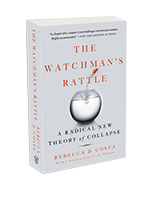
So begins Rebecca Costa's much awaited exploration of foresight: "the crowning achievement of human ambition." According to Costa, never before has the information needed to avert danger, get the jump ahead of others, or prepare for the inevitable been so clearly within grasp. Advances in Big Data, predictive analytics, genomics, artificial intelligence, and other technologies have made it possible to pinpoint future results with mindblowing accuracy—cracking the door to what Costa calls predaptation: the ability to
Through fascinating real-life examples, Costa reveals how technology has brought nations, businesses, and individuals to the edge of clairvoyance. Yet, our ability to act on foreknowledge often falls short—causing leaders to squander the advantage of preemption. To counteract this failure, Costa illuminates 12 principles of adaptation, and predaptation, used to succeed in fast-moving environments. |
About the Book
An interview with Rebecca D. Costa
author of On the Verge
Q: Your new book, On the Verge, is about foreknowledge and leadership. Why foreknowledge?
A: The short answer is that foreknowledge is having a profound impact on how leaders lead. It's no longer enough to be nimble, innovative, and quick—not enough to rack up 10,000 hours of experience, master the 7 habits of successful people, or transform ourselves into
1-Minute managers. These skills are no match for the ability to foresee and manipulate future outcomes, events, and trends to our advantage—which is what Big Data, predictive analytics, and artificial intelligence have equipped
leaders to do.
When you stop and think about it, we have more information—more empirical data—about the future than at any other time in human history.We know when a hurricane, tornado, or tsunami is en route; when a country's currency is on the verge of collapse; which automobiles are the safest in an accident; when and where the risk of a terrorist attack is high. We know whether a person is predisposed to opioid addiction long before a doctor writes the first prescription; when a country is on the brink of producing a nuclear weapon; whether we're programmed to suffer from breast cancer, Alzheimer's, baldness, obesity, depression, or cardiovascular disease. We can anticipate food, rare earth mineral, oil, and nursing shortages; whether a company will meet their quarterly earnings; when an airplane, nuclear power plant, and toaster will reach the end of its life cycle. On every front, our knowledge about events that have yet to occur grows more precise. And with foreknowledge comes the opportunity to act before the fact.
Q: What do you mean by "act before the fact"?
A: I mean that we are approaching a time when all future outcomes and events will be known. So, leaders can avert undesirable results and manipulate the social and physical environment to their advantage. Those who master predictive analytics and other advanced technologies aimed at anticipating future outcomes, events, and trends will have the upper hand. Others will find themselves adapting to an environment where the odds are stacked against them. The more precise our predictions become, the worse things get for those with limited resources.
Q: In your book, you talk about leaders who predapt. What is predaptation?
A: Predaptation means proactively altering the environment to which we will adapt. In biology, adaptation refers to the physical evolution that occurs as a result of changes in an organism's habitat. Similarly, when changes occur in the business, social, and political environments—such as the proliferation of the internet, or new laws and regulations—individuals and organizations must also adapt. That said, for more than 150 years, our views on adaptation have remained largely unchanged. We treat adaptation as some random roll of the dice, over which we have little or no control. But our growing stockpile of foreknowledge is changing that. Foreknowledge makes it possible to adapt before the fact.
Q: Can you give us an example of predaptation at work?
A: Several years ago, when the cost of gasoline began rising, it was only a matter of time before packaged food makers were going to have to raise their prices. According to the principles that govern modern economics, this would decrease the overall number of units sold. But thanks to foresight, these manufacturers predapted. Instead of raising prices, they opted to keep the price and package size of everyday consumables (like cereal and chips) as-is and decrease the contents instead. In this way, consumers felt as if they were getting the same value. And since perception is reality, food makers were able to cover the additional transportation costs with very little disruption to sales. By predapting to what they could foresee was coming, they were able to alter the future to which they, and the public, would adapt.
Now that's a simple example of using foreknowledge to shape future outcomes to our advantage. So now let's take a more complicated example such as genetic testing. Thanks to the human genome project we are approaching a time when diseases we are genetically predisposed to—diseases such as cancer, depression, and so on—will be treated by gene therapy before we experience the first symptom. In this way, healthcare is predapting: using foreknowledge to
change our future.
Q: In On the Verge you demonstrate how 12 principles used to adapt in nature can be used by businesses, governments, and organizations to predapt. How did you come up with the 12 principles?
A: As a sociobiologist, my perspective is skewed by what I observe in nature. But that's nothing new. In the 1800s, one of the fathers of modern economics, Alfred Marshall, observed parallel forces in evolution and economics. He drew from Charles Darwin's work to explain gradualism in financial markets. Similarly, many of the ideas forwarded by Joseph Schumpeter, Thomas Jefferson, Karl Marx and others were derived from the natural world.
The 12 principles of adaptation I describe in On the Verge are those that have been tested and proven and have endured for millions of years—and that successful leaders use to adapt and predapt today.
Q: Which brings us to the book title—why On the Verge?
A: When it comes to foreseeing future outcomes, events, and trends, we are rapidly moving from guesswork to absolute certainty. Big Data computing, predictive analytics, and artificial intelligence are making it possible to string together extremely elaborate, complex algorithms capable of assessing what's coming our way with unprecedented precision. And while we are not quite there yet, there is no doubt that foreknowledge will be the next big disruptor. From how we wage war, invest, and remain healthy to how we manage and lead, foreknowledge changes everything. We are "on the verge."