

|
|
 |
Articles
May 17, 2015
FCC Commissioner Mignon Clyburn says 'Net Neutrality' protects an American rightThe Federal Communications Commission (FCC) is generally known for making headlines when a celebrity's wardrobe "malfunctions" during Super Bowl half-time, but there's no question that overseeing the nation's telephone, television, radio and Internet infrastructure touches every aspect of American life. Recently appearing on The Costa Report, Commissioner Mignon Clyburn noted that the communications industry is currently responsible for one-sixth of the U.S. economy. "The FCC is one of the most-significant government agencies that people don't speak about, unless there is an incident that warrants some attention," Clyburn said. The FCC's most recent challenge has been neutralizing the effect that Internet users — those who rely on streaming extremely large files — are having on smaller users who are equally dependent on the Internet. The FCC recently voted to approve a controversial "Net Neutrality" policy aimed at ensuring a level playing field for all Internet users. Clyburn compares the Internet to utilities such as electricity, water, and telephone service, and says "Net Neutrality" prevents any individual or company from using money, power, or influence to gain faster, more-reliable broadband service. "There is nothing you can do today in business or in your personal life that does not require a communications underpinning," she said. "What we (at the FCC) recognized, and what congress so aptly recognized, is that markets are essential, and that we should be supporters of innovation and investment. But markets are not perfect, and that's why you have an agency like the FCC." Clyburn says her agency is responding to over 4 million American citizens who have weighed in on Net Neutrality, overwhelmingly indicating that they do not want to experience Internet performance degradation as a result of large users. The commissioner said investigations by her agency uncovered multiple instances in which slowdowns have occurred, prompting the FCC to act before slow, disrupted Internet service became problematic elsewhere. "We have recognized that these are essential services, and access to that is clearly important," she said. "We want to make sure that no provider is able to make someone's broadband experience slower or faster --- that no individual or company can prioritize or pay someone to have a faster, more-robust experience. This is why it was so important for us to have some high-level rules to ensure that everybody's opportunities online are equal." Clyburn said the FCC has a Universal Service Fund of almost $9 billion per year, much of which is used to subsidize internet access in sparsely populated rural areas where there is no economic incentive for service providers to expand. "Communities need this kind of infrastructure. It is as important as water and roads," she said. "We're working with providers in a private-public partnership to bridge that gap, because it is about money, and it is about having the margin they need to be profitable. We have to recognize that, so we are proactively investing in those communities that are very expensive to serve." "Our citizens have told us they want a platform in this space that is reflective of the American experience, reflective of our ideals: freedom of speech, freedom of opportunity, freedom of expression." To hear the full interview with FCC Commissioner, Mignon Clyburn, visit rebeccacosta.com 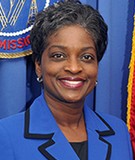
Week of May 11, 2015 Mignon Clyburn
Mignon L. Clyburn is a Commissioner of the Federal Communications Commission (FCC), and also served as the Acting Chairwoman of the FCC, in the interim period between the departure of Julius Gena-chowski and the confirmation of Tom Wheeler. Prior to her nomination to the FCC, she served for 11 years as the representative of South Carolina's 6th congressional district on the South Carolina Public Service Commission (PSC). Preeding her service on the PSC, Clyburn was the publisher and general manager of The Coastal Times, a Charleston-based weekly newspaper that focused primarily on issues affecting the African American community. A longtime champion of consumers and a defender of the public interest, Clyburn was designated a Women's History Month Honoree by the National Women's History Project, in 2009. |
|

Articles
2021
October
July
February
2020
March
2019
December
January
2018
February
January
2017
December
October
September
August
July
Article Archive >
|
 |
|
 |