

|
|
 |
Rebecca CostaThe Dehumanization of EntrepreneurshipDiegetic Business
January 15, 2012
Brenda Laurel identifies a crisis in contemporary entrepreneurial practice: "We face a crisis in content – who will make it, how will it be paid for, and what will it be worth in a new media world?" Entrepreneurial practice, and innovation in general, is now driven by the acquisition of content. It is no longer a form of authorship, but instead of collage. This crisis, in part, can be attributed to society's desire for a constant "newness," but perhaps entrepreneurs have simply run out of ideas. I believe we are headed towards an era of sameness – an era in which innovation by the human species alone is impossible because all humanly perceivable problems are solved. While, to some, the elimination of problems may seem to be a great success, I find it to be the most pressing dilemma of mankind. As utopian socialist and business man, King Camp Gillette, states, the progress of humanity is dependent on the birth of ideas, and "if individual minds should cease to give birth to ideas of improvement or discovery, the progress of man would cease." Entrepreneurship, the design of new stuff as a result of our innate empathy towards others, is what makes us human. To strip innovation and ingenuity out of the human equation is to strip the very thing that makes us unique as a species.
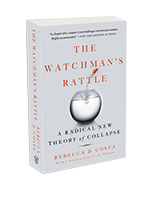
As Research Scientists in the field of Quantum Physics attempt discovery, breakthrough is revealed in that which is counterintuitive. For example, 0.999… is equal to 1. In this space, human intuition becomes irrelevant because the areas explored are not comparable to that of any past experience. The same can be said about the very distant future. Both are spaces in which common sense, alone, is considered shortsighted. In this space as well as other domains in which expertise is not possible, like stock picking or long-term political strategic forecasting, experts are "just not better than a dice-throwing monkey." As we continue to rapidly move towards a future, and past experience exponentially divides from present conditions, as Rebecca Costa illustrates with the two clocks of human governance, an era in which innovation by human kind will come to a screeching halt and mankind will become an unnecessary component, marking the end of entrepreneurship. The above diagram portrays a map of the future, from the perspective of the present. The map is made up of a cone that has two axes (existing condition and past knowledge) that are exponentially dividing with a timeline in the middle. The diagram, specifically the ultimate break in the connectivity between the axes, illustrates the context that my project is designing for, and gives a broader framework to the speculation as a whole. The first axis, existing condition, represents our current state – the pressing issues, conditions, or needs. The second axis is our knowledge and experience. This axis represents everything we have learned in the past that directly inform the way we approach the existing condition. The bridge between these two is entrepreneurship – the ability to see the problems that exist in our present moment, consult our past knowledge, and juxtapose the two in order to solve the problem by creating an enterprise. As we move through this cone, and we enter this exponential divide between the two axes, it becomes harder and harder to innovate because the void between our existing condition and our past knowledge / experience grows to a point until one day, in which I speculate, this gap will not be possible to cross. The specific reason for not being able to cross this bridge is difficult to identify, but the reason this thesis focuses on is the speculation that we will run out of humanly perceivable problems. We are entering a time in which every humanly comprehensible problem, discomfort, and inconvenience has been solved. This thesis is not claiming that all problems are indeed solved. Instead, I am arguing that the problems that do exist are not discoverable or identifiable by mankind. We need to begin designing an alternative for this situation, a machine – the Dehumanized Entrepreneur. This machine, and the algorithms that inform it, are designed to dehumanize entrepreneurship by making visible the connection between our past experience and existing condition in order to systematize innovation for a time in which humans become an irrelevant component of entrepreneurial practice. |
|
 
|
 |
|
 |