

|
|
 |
Rebecca CostaIs Social Media being driven by “Extreme Economics"?High Talk
September 21, 2011
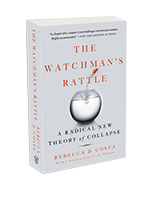
In her fascinating book "The Watchman's Rattle," Rebecca Costa talks about a super meme known as "extreme economics." For those unfamiliar with the concept of memes (rhythms with "seems") they are units of cultural transmission or imitation and like real genes they compete for survival, some winning and others dying out. They also evolve with time. Super memes are those beliefs and ideas that become so ubiquitous that they direct the way we think and behave as a culture and a society – without society really knowing that the meme is in place. One example of a super meme is religion – a belief so ingrained in culture and society that few question it. In her book, Costa identifies another super meme "extreme economics." As Costa explains this is the super meme where "we begin applying the strategies we use to succeed in business to the other areas of life." For example, in healthcare or government. If something isn't economically viable or doesn't have a business model attached to it, society simply won't embrace it even if it will benefit everyone. We can see this meme in action with alternative energy. For example, we already have the technology available to operate automobiles with electricity or hydrogen, yet we haven't widely adopted these extremely beneficial technologies because they the cost would be too high to replace the cheaper gasoline economy we currently have. These alternatives simply lack a strong economic incentive so they are not widely accepted. I'd like to offer up the observation that the "extreme economics" super meme has invaded and is changing – quite drastically – social media and social networks. Social media was once thought of as a media for the masses. Anyone with an internet connection could create a blog or open a social network account and begin to publish content – opinions, articles, fiction, photography, drawings, videos, graphic design, etc. There were few forms of content that couldn't be published and instantly shared – for free. However, in the last couple of years the desire to "share" and "create" in the name of expression has quickly been dwarfed and overrun by "extreme economics." We are moving toward "paid" media – rather than social media. While some commentators, like Tom Foremski of the Silicon Valley Watcher, worry that social media is being taken over by corporate voices, I worry that many of the top social media content creators are already turning themselves into corporations. The signs are everywhere:
What do you think? Was it inevitable that bloggers and other content creators on social media platforms would demand payment? Is this a good thing or a bad thing? Or does it even matter? Does it matter to you if content is sponsored or if a blogger was paid to write a blog post? And how should brands react? Should they pay for content and syndication? All questions everyone in the industry will be wrestling with in the months and years to come. |
|
|
 |
|
 |