

|
|
 |
Rebecca CostaHow to Overcome FailureDon't Fear Failure, fail fast, harness data and adapt
August 8, 2013
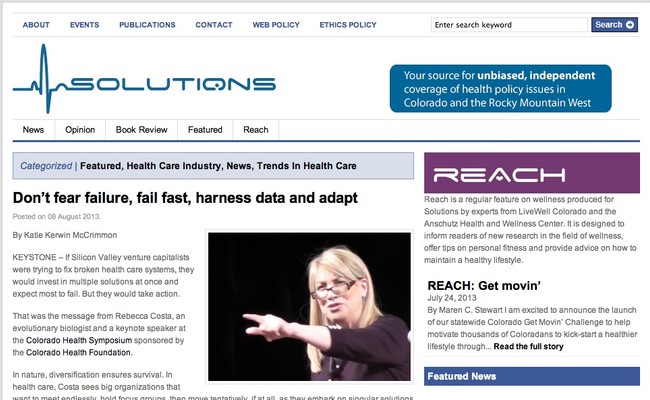
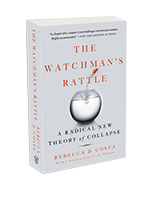
KEYSTONE – If Silicon Valley venture capitalists were trying to fix broken health care systems, they would invest in multiple solutions at once and expect most to fail. But they would take action, and overcome failure. That was the message from Rebecca Costa, an evolutionary biologist and a keynote speaker at the Colorado Health Symposium sponsored by the Colorado Health Foundation. In nature, diversification ensures survival. In health care, Costa sees big organizations that want to meet endlessly, hold focus groups, then move tentatively, if at all, as they embark on singular solutions destined to fail at a glacial pace. "Singularity is a drive toward extinction," said Costa, a former CEO of a Silicon Valley marketing firm, a radio host and author of the book, "The Watchman's Rattle: A Radical New Theory of Collapse." "Any time anybody is betting on one solution, you've got a problem," Costa told health experts from around Colorado and the U.S. as they gathered to ponder how to harness the power of change. Even the best brains can't bet right all of the time. So successful venture capitalists — or health reformers — accept that they are working in a high failure environment and they jump in to try to solve problems. Costa compared two attempts at handling high-profile disasters: one that worked and another that failed. When the Chilean government rescued 33 miners who had been trapped underground for two months in 2010, Costa said they made a wise choice to simultaneously pursue 33 possible rescue plans. Many failed. But one succeeded. Conversely, that same year, when an explosion and fire at a BP rig in the Gulf triggered a massive spill, oil gushed for 85 days as Americans watched horrified but powerless as the environmental disaster played out in real time. Costa said that was an example of leaders pursuing singular solutions that failed in succession until a cap finally held far too late to prevent irreversible damage. As health policy experts move forward, the key is to explore multiple solutions and measure results. "The big elephant in the room is irrational human behavior," Costa said. "Everyone's in violent agreement. We know what needs to be getting done. It's not getting done." In health care, complexity is killing innovation and thwarting action. "Having a million options is equivalent to having none. Complexity is the real issue we're up against," Costa said. "We are time impoverished." In biology, change happens over millions of years. But our brains can't keep up with the speed of change as a rush of data overwhelms us.
So how do humans overcome a high error rate and the paralysis of too much complexity? The key is to use reason and take action, Costa says. "Go for the failure. Fail fast. Leverage big data and mobile data and crowdsources. Avoid belief-based decisions." And, advised Costa, sometimes you have to turn complex challenges into snakes. "We are simply not biologically wired to worry about long-term problems," she said. That's why young people — and most others — shrug off worries that Social Security and Medicare will someday go bankrupt. "Once you know that, you have to make everything a snake. Don't say we could have this problem a year down the road. The snake is going to bite us today. Now you've got our adrenaline going." |
|
 
|
 |
|
 |