|
|
 |
Rebecca CostaThe Watchman's Rattle - Green Advantage
February 3, 2015
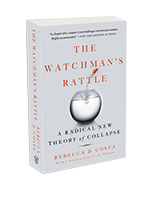
I recently read a very interesting book entitled "The Watchman's Rattle: A Radical New Theory of Collapse" (Rebecca Costa, 2010), which offers an evolutionary explanation for modern problems such as government gridlock, terrorism, obesity, the decline in education, violence, etc. In the book, Costa discusses reasons why the global stage may be set for collapse, including several "supermemes" (defined as "any belief, though, or behavior that becomes so pervasive, so stubbornly embedded, that it contaminates or suppresses all other beliefs and behaviors in a society). She does, however, finish on a positive note, so don't despair! "The uneven rate of change between the slow evolution of human biology and the rapid rate at which societies advance eventually causes progress to come to a standstill." According to Costa, this is because the traditional left brain/right brain problem-solving methods that are species has developed over the millennia become no longer sufficient to address the most dangerous threats. What it means is that a cognitive threshold has been reached. The first symptom of this threshold is gridlock, where civilizations become unable to comprehend or resolve large, complex problems, despite acknowledging beforehand that these issues may lead to their demise. The second symptom is substitution of beliefs for knowledge and fact, which can be seen by anyone following the climate change issue (or for that matter, almost any other major issue facing society). Once these two symptoms arise, the stage is set for collapse. There is an increasing gap between the slow rate of evolution and the rapid pace of human progress, and according to eminent biologist Dr. E.O. Wilson, "The real problem of humanity is the following: we have paleolithic emotions, medieval institutions, and god-like technology." Costa goes on to discuss five supermemes: Irrational Opposition occurs "when the act of rejecting, criticizing, suppressing, ignoring, misrepresenting, marginalizing, and resisting rational solutions becomes the accepted norm," and where "opposition has become a new substitute for advocacy." This results in gridlock, especially when the resources required to overcome the irrational opposition are too great. The Personalization of Blame occurs when" leaders become unable to solve complex, dangerous issues, [and] they begin shifting the responsibility for correcting these threats to individuals. As this occurs, all the attention, resources, and efforts to address deeply-embedded social failures are set aside in favor of persecution." One example of this was the 2008 effort to blame auto industry executives exclusively for the system-wide problems in their industry, when in fact the industry deeply tied into and affected by problems in the global economic system. "Blaming one person for our troubles is akin to blaming the Pope for a shortage of parking spaces at the local church." Counterfeit Correlation is a result of three convenient practices: accepting correlation as a substitute for causation, using reverse engineering to manipulate evidence (think revisionist history), and relying on consensus to determine basic facts, all of which together have the power to make beliefs appear as facts. According to Jon Stewart, "Since when are facts something you vote on? According to Wikipedia, if we all agree then its a fact. Is that all it takes? Just agree? I though facts were something else." And according to Alan Greenspan: "Gentlemen, you are each entitled to your opinions, but you are not each entitled to your own facts." Silo Thinking is probably one we are all familiar with, wherein exist "compartmentalized thinking and behaviors that prohibit collaboration needed to address highly complex problems." It causes undermining, competition, divisiveness, and inaccessibility of information. "Silo thinking makes it extremely difficult to fix a systemic problem because no one silo is responsible for the overall problem." Extreme Economics is where "simple principles in business, such as risk/reward and profit/loss, become the litmus test for determining the value of people and priorities, initiatives and institutions." Unfortunately, broad solutions that benefit all of us do not always fit into these accepted models, and progress is therefore inhibited. Costa goes on to discuss potential solutions to these problems that can help us progress on the major issues facing us, such as parallel incrementalism (where we address all aspects of an issue, on all fronts, together), restoring the balance between knowledge and beliefs (e.g., by preserving the integrity of our educational institutions), and five additional ideas:
"Preparing the human mind for complex problem-solving offers the single greatest socioeconomic advantage possible across all fields and all industries." I highly recommend this book to all. I don't necessarily see that society is on the verge of collapse, but I do see evidence of these supermemes in many aspects of society today. |
|
 
|
 |
|
 |