|
|
 |
Rebecca CostaDeep in the Heart of Brooklyn
October 28, 2010
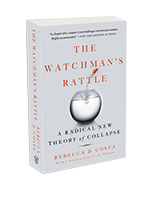
The Watchman's Rattle by Rebecca Costa suggests that the only way to move civilization out of what appears to be its current decline is clear thinking. Rebecca Costa is a sociobiologist and evocative speaker whose unique expertise is to spot and explain emerging trends in relationship to human evolution, global markets, and new technologies. She lives on the central coast of California. The book offers insights into the importance of, well, insight--- how the human mind can be overwhelmed in attempting to create solutions to the multitude of large scale and complex problems that we currently face. that we're stuck is the first step towards getting out. With lessons from history, she demonstrates why it can be so difficult for humans to think our way out of complex problems, and more importantly, how we can nurture the kind of insight that will bring us forward. In his foreword to the book, eminent sociobiologist E.O. Wilson says "I am on the side of Rebecca Costa. Let us become realists-in-search-of-a-solution rather than doomsayers." In an interview in the Harvard Crimson, Ms. Costa states: "The first third of my book is looking back into past history to see what happened to the people before the cataclysmic events occurred that caused them to collapse. I go into the history of the Mayans, the Romans, the Egyptians and the Khmer, and it turns out that there are two signs that begin to occur very early on prior to the collapse, several generations beforehand. That is, that they become gridlocked, unable to solve their problems, as the problems are getting worse and worse, until eventually, one of them can't be stopped. The second thing that happens is, when the facts become too complicated, when the problems exceed the cognitive capabilities that we as a biological organism have evolved to that point… We substitute beliefs for facts. There's an abandonment of rational problem-solving that goes on…and that leads to collapse." That sounds like grim news, indeed. So, if our problems exceed our cognitive abilities, how can we fix those problems? Ms. Costa: "We have two things, in my view, available that ancient civilizations did not have. One: we have models for high failure rates, for situations when no amount of due diligence will allow you to pick the solutions that will work from the solutions that won't work. The easiest one to grasp is venture capitalism. Venture capitalists are experts at failure. They're not really experts at success. For every 100 companies they invest in, 80 are going to be average or fail. 20 percent are going to be so spectacular that it diminishes the failure.
So, that said, how do we maximize our use of insight? Costa: "What we need to do is develop insight on demand… But because we can't evolve on demand, that's why mitigation is so important. When you know that you're up against complexity that exceeds what the human brain has evolved to be able to handle, then you can mitigate, but you must also do everything possible to catch the brain up to complexity." Excerpt from "The Watchman's Rattle" In an article online, Ms. Costa addresses the complex issues that we currently face during these "Oppositional times" : "It must be obvious that we live in oppositional times. "No matter what candidate, ballot measure, idea or program we put on the table, those who will oppose it always far outnumber those who are willing to advocate. It isn't even a close call.
"For example, take increasing our troops in Afghanistan, illegal immigration, healthcare, social security, epidemics of autism and depression, climate change and offshore drilling regulation. Opposition everywhere. It doesn't matter which side we take, we don't like what has been proposed, though we don't really have any solutions either.
"The answer lies in a pattern of human behavior that is as old as the organism itself. "When the complexity of the problems we must solve exceeds the cognitive abilities we have evolved to that point in time, we reach an impasse. In a nutshell, human beings cannot progress any further than evolution will allow. We simply do not have the biological capacity to understand and solve every problem we face, despite having the biological imperative to continue progressing. So what do we do? History shows that we begin substituting unproven beliefs for facts and rational thinking. Over time, irrational beliefs find their way into public policy and once this occurs, great civilizations begin to decline.
From the article by Ms. Costa on "The Oppositional Society." "Interesting stuff, but does it offer real solutions ?" I think the author would point at the previous line as the sort of oppositional thinking, the challenge of any actual plans, policy or actions, as hopeless, with a response that is negative and which could only serve to continue to push society and our future into the spin cycle, with little hope or direction. In short, chances of progress very dim indeed. We need to TRY SOMETHING — and maybe more than one thing at once, instead of just arguing back and forth, endlessly criticizing ideas and proposals, with no alternative proposed. Insight, ideas, and action could lead to real progress for some of the most critical problems and issues that we face. And that is the true north to which "The Watchman's Rattle" urges that we move. For more on the book and the author: https://www.rebeccacosta.com/. |
|
 
|
 |
|
 |