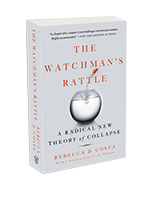
Following on from part one, here's a further delve into 'The Watchman's Rattle – A Radical New Theory of Collapse' by sociobiologist Rebecca Costa.
We face many highly complex problems such as climate change, terrorism, pandemic viruses and nuclear proliferation.
Costa suggests a number of reasons why using short-term mitigations (tactics) to tackle such problems fails:
- They often become confused with a permanent solution.
- They remove the sense of urgency to resolve our problems (e.g. give the impression that the problem is solved when the symptoms begin to recede).
- Individual mitigations prevent systemic problems from being solved in a systemic way.
- They are not sustainable.
- We take a serial approach to improvement – one finger in the dike at a time despite there being ten holes.
So what to do?
In the short-term, parallel incrementalism is:
- A mitigation strategy whereby the cumulative effect of executing multiple, incrementally useful mitigations in tandem is exponentially more effective that implementing them one at a time.
- The most effective way to leverage mitigations when problems become too complex to be understood or managed.
- Illustrated by the collaborative effort of the Allies during World War II.
- At work amongst venture capitalists who are in the business of making many more wrong calls than right ones. The key is to make enough calls so that the successes have an opportunity to neutralise the losses.
What about more permanent solutions? Costa suggests modern man has two weapons earlier civilisations didn't:
1. Restore the balance between knowledge and beliefs
One of the ways we break the historic pattern of human ascension and decline is to vigilantly maintain a balance between civilsation's pursuit of beliefs and facts…when a society elevates the pursuit of knowledge, it counteracts the encroachment of beliefs and, in effect, inoculates a civilisation against supermemes. Think of facts and knowledge as powerful vaccines that protect us from surrendering to irrational beliefs.
2. The evolution of insight
…insight can be viewed as nature's gift: a brilliantly efficient way to cut through thousands of variables, multiple wrong solutions, and produce a correct and elegant answer. Whereas traditional left- and right-brain problem-solving methods become overwhelmed by complexity, insight soars right through chaos – much like a hyper-efficient editor who instantly isolates knowledge that is essential to a solution from facts that are not.
Costa concludes:
Today, for the first time in history, neuroscientists have the ability to look inside the human brain and witness insight's true talents. They acknowledge that insight is spontaneous and rare, but it is also the only known cognitive antidote to complexity. But in addition to discovering insight, we are also the first civilisation to have the knowledge, technology, and resources to stop the pattern. No other civilisation before us had such command over its environment and so many tools at its disposal to alter the course of human ascension and collapse. And, therefore, no other civilisation has had so much cause for optimism.