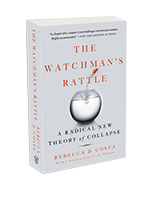
Here's what she has to say:
- The point at which a society can no longer "think" its way out of its problems is called the cognitive threshold – the difference between the slow speed at which the human brain can evolve and the rapid rate at which complexity grows.
- Gridlock occurs when civilisations become unable to comprehend or resolve large, complex problems, despite acknowledging beforehand that these issues may lead to their demise.
- A society advances quickly when both human needs – belief and knowledge – are met. However, when complexity makes knowledge impossible to obtain, we have no alternative but to defer to beliefs; we accept assumptions and unproven ideas about our existence, our world.
- Once a society begins exhibiting the first two signs – gridlock and the substitution of beliefs for facts – the stage is set for collapse.
- A supermeme is any belief, thought, or behaviour that becomes so pervasive, so stubbornly embedded, that it contaminates or suppresses all other beliefs and behaviours in a society. They are often a response to accelerating complexity.
5 key supermemes
- Irrational opposition: occurs when the act of rejecting, criticising, suppressing, ignoring, misrepresenting, marginalising, and resisting rational solutions becomes the accepted norm. When opposition evolves into a supermeme, solutions to our greatest threats may be prevented from coming to fruition because the resources required to overcome the opposition may simply be too great.
- The personalisation of blame: foisting the responsibility for complex problems onto the shoulders of individuals whenever complex problems persist. The truth is that we haven't yet developed efficient processes for thinking about and solving massive systemic issues.
- Counterfeit correlation: in an impatient, correlation-addicted world, scientific standards have been lowered to accommodate correlations that often have little or no relevance to root courses.
- Silo thinking: compartmentalised thinking and behaviours that prohibit the collaboration needed to address highly complex problems.
- Extreme economics: simple principles in business, such as risk/reward and profit/loss, become the litmus test for determining the value of people and priorities, initiatives and institutions. Economic considerations overwhelm other values to such an extent they now have the power to decide how and if humankind's greatest threats will be solved.
Costa writes:
Supermemes eventually become so pervasive that they overwhelm all social institutions, customs, values, and rational thinking…As these supermemes grow stronger, they cause singular ways of behaving and thinking. Singularity in turn suppresses helpful solutions from coming forward…Eventually, one of our systemic problems becomes so colossal that it results in collapse. The final blow can come in many forms: a pandemic virus, global warming, nuclear war. It doesn't matter which unresolved problem goes uncured, one of the threats eventually becomes too massive for the collective resources of a civiliasation to stop.