 Press Room Press Room

|
|
 |
Press RoomWhen it comes to voting, is it ever right to abstain? Five-time Presidential candidate Ralph Nader has a better idea.
January 25, 2016
No one would argue whether the right to vote is a cornerstone of democracy. Or whether the U. S. is dominated by a two-party system - parties which will soon choose their 2016 Presidential nominees. Assuming recent polls hold, in November Americans may be asked to choose between billionaire businessman, Donald Trump, and former Secretary of State, Hillary Clinton. Trouble is, both have issues. Trump has never worked in government, so his "take no prisoners" approach isn't conducive to a system that limits the authority of elected officials. On the other hand, even with experience, Clinton's record as an elected official is so poor it has made having no record look reasonable. Which begs the question, what if you don't think either candidate is right for the office? Is it ever right to abstain? Last week on The Costa Report, five-time presidential candidate, Ralph Nader, offered two solutions to a conundrum many Americans will face in November. First, Nader encourages unpersuaded voters to "exert an act of conscience" by writing in the name of the candidate they support. "I would not become a tactical voter. I would write in my preferred candidate," explained Nader. Sounds simple. But is it? Well for starters, it won't work in every state. Hawaii, Nevada, South Dakota, Oklahoma, and many others don't allow write-ins. And other states are quickly moving to remove this option. So, that's the first problem. Then there's the second issue: even if a voter has that option, do write-ins ever work? The short answer is yes, but not often ... In 1954, a write-in campaign worked for South Carolina Senator Strom Thurmond. He garnered 63 percent of the votes against opponent, Edgar Brown. Ohio Congressman, Charlie Wilson, was also a victorious write-in, as were Congressmen Joe Skeen, Dale Afford and Charles Curry. And write-ins have made a difference in previous presidential primaries. From Herbert Hoover, Franklin Roosevelt and Thomas Dewey to Taft, Eisenhower, Nixon and Kennedy – write-in votes decided who took the primaries. Even so, a write-in candidate hasn't won an election in the U.S. in decades. So while Nader urges voters to take the moral high ground, it's a long shot at best - a long shot opponents say is the equivalent of "throwing your vote away." And who wants to register, take time off of work, stand in line, and write in a name that won't make any difference? That said, write-in opponents will find it difficult to argue with Nader's second cure. He urges the government to add a simple "none of the above" option for voters who want to exercise their right to vote, but not for the available candidates. The way this would work is, if "none of the above" received more votes than the ballot candidates, the election would become void and a new election held. Think of it as a "reset" option. Everyone starts over – including a new field of hopefuls. In a bold move, in 1976 Nevada added a "None of These Candidates" option to their ballots. But according to Nader, they didn't go far enough. The option is nonbinding. So even if "None of These Candidates" secures the highest number of votes, the candidate who receives the second highest wins office. Sixteen years ago voters in California tried to get a stronger measure put through. But, fearing government gridlock, the initiative was defeated in a general election. Seems Californians would rather elect a placeholder than suffer through a second round of nonstop commercials, debates, fundraisers and stump speeches ... When it comes to a Presidential election, how would the "none of the above" option actually work? Since there is no legal provision for the term of a sitting President to be extended, it would mean the Speaker of the House would temporarily take custody of the Executive Office until a second election could be held. It would also mean that all of the prior fund raising, advertising, campaigning, and backroom dealings would become worthless. Big political backers would lose their campaign "investments" overnight. So they'd face starting over with a candidate that failed to inspire the majority of U.S. voters the first time around, or backing a new candidate that citizens really want. Following that logic, over time, the two political parties would begin nominating candidates who had greater broad-based appeal. After all, their chief opponent would no longer be the opposing party's nominee. The bigger challenge would be to beat "none of the above." In short, to turn the tide of disenchanted voters. Given a choice between abstaining, voting for a candidate we don't support, or writing one in who can't win, is there any doubt Americans would choose Nader's fourth option? Any doubt the two parties would offer better options than a billionaire who would have trouble passing a high school civics exam and a woman who is accused of so much wrong doing that - even if only five percent of it is true - should be serving time? Any doubt more voters would show up at the polls to perform their patriotic duty? Here Nader has the final word: "When people know that their vote matters, they are going to be more motivated to turn out." 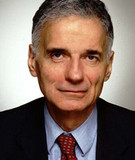
Week of Jan 18, 2016 Ralph Nader
Ralph Nader is an American political activist and a five-time presidential candidate. Nader is known as a consumer advocate, first recognized in 1959 for his criticism of the automobile industry in an article he wrote for The Nation called "The Safe Car You Can't Buy." Time magazine has twice named Nader ‘One of the 100 Most Influential Americans in the Twentieth Century.’ Nader has founded several organizations, including The Center for Study of Responsive Law, The Center for Auto Safety, Democracy Rising, The Center for Insurance Research, and Citizen Works. |
|
|
 |
|
 |