|
|
 |
Rebecca CostaCoronavirus: a lesson on exponentiation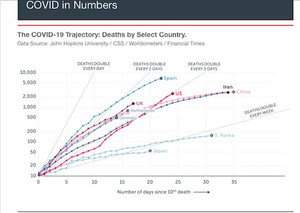
March 11, 2020
If there is one thing the human brain isn't designed to do well, it is to think in exponential terms. Over many millions of years our brains evolved to solve problems in a linear manner. And this makes fast-moving epidemics like COVID-19 dangerous. Because linear thinking causes us to think we have more time than we do. The example often used to illustrate how quickly exponentiation ratchets up is the fictitious story of lily pads in a pond. Imagine a beautiful pond with one lily pad. Every day the number of lily pads in the pond will double. So, on day two, there will be 2 lily pads. On day three, 4 lily pads. On day four, 8 lily pads. And so on and so on. In 36 days the entire pond will be covered with lily pads. And fish and other lifeforms will be crowded out and begin to perish. If it takes 36 days for the pond to be covered, on what day will the pond be half covered? If you're an evolved linear thinker, you divided 36 days by 2. Your answer is that on day 18 the pond would be half full. So, if follows that you have 18 days prior to the catastrophe to stop lily pads from spreading. But this is incorrect. If the number of lily pads is doubling every day, the correct answer is that on day 35 the pond is half full - just 24 hours before the pond is completely covered. The fact is, as late as day 30, the pads occupy such a miniscule area of the pond it's hardly cause for alarm. But sometime between day 35 and 36 exponentiation triggers a crisis. Though it feels like it happened overnight, this is how exponentiation works. Highly contagious viruses - particularly unfamiliar strains which transition from animals to humans - are dangerous precisely because they can exponentiate. Using the lily pad example, if on day 36 one million people are forecasted to be infected, six days earlier less than sixteen thousand would have the disease. That's right. The figures leap from sixteen thousand to 1 million in a mere 144 hours. For this reason, I am among a few scientists who are not against panic. When it comes to exponentiating threats, the time to panic is now, not later. Think of COVID-19 as a snowball rolling downhill. It is magnitudes easier to stop a snowball when it's the size of your hand, rather than the size of a building moving at top velocity. To this end, leaders, media personalities and healthcare experts who are urging calm are doing a grave disservice to the public. They're treating the spread of the virus as if the number of cases will grow in a controlled, manageable, linear fashion. And in so doing, creating the illusion there is ample time to prepare hospitals, healthcare workers, nursing homes, schools, law enforcement, etc. Ample time before ordering border closures, mass quarantines and shelter in place. Ample time to develop a vaccine. But if there was previous hope a vaccine might appear that hope has been dashed by the discovery of new COVID-19 lineages. The virus is mutating. This means that even if a vaccine does emerge, it will only address some of the lineages, not all. Depending on how many more mutations occur, a Coronavirus vaccine may be about as effective as the flu vaccine we line up for each season - a vaccine designed to immunize us from a miniscule number of potential strains and more ineffective than effective (less than 40 percent). The idea that scientists are going to make a miraculous last inning save is further contributing to a false sense of security. A sense of security buttressed by the idea the virus can be stopped in its tracks by washing our hands and not touching our face. Yesterday a friend of mine who runs a well-respected estate planning law practice called to see if I had any suggestions for keeping his elderly clients safe. He explained he had installed hand sanitizing areas near the elevator, in the front lobby and in all the conference rooms. He also asked the janitorial service to wipe surfaces such as chairs, tables, light switches and door handles three times a day with disinfectant. He was determined to do all he could to create a virus-free environment for his staff and clients. My response? "That's great, but what happens when someone coughs?" One cough and all of it was for naught. The answer for lawyers like my friend and other service providers is to use existing technology in a way that does not require those who are susceptible to meet face to face: Skype-like video conferencing, Docusign-like online signature services, and dozens of other online tools available 24/7. Most of the benefits we associate with face-to-face meetings can easily be managed remotely. If we choose to. And we should choose to. And choose to now. Exponentiation informs us that in the blink of an eye the Coronavirus will spread in numbers we have yet to experience in modern medicine. "Social distancing" will soon be replaced by orders to "shelter in place." And commerce must rapidly adapt to this new reality. To this end, panic serves as an urgent motivator. A motivator to deploy drone and robotic delivery sooner than later; to use 3D-printers to manufacture pharmaceuticals from the comfort of homes; to rely on driverless emergency vehicles to transport the sick to secure facilities; to form a scientific research facility with scientists from every country who are tasked with monitoring and stopping biological threats; to transition away from physical to electronic currency; to make the changes necessary to protect individuals from becoming unwitting agents and victims of exponentiation. We have the technology to stop contagion. We have the technology to protect interruptions in commerce from this virus and other threats to human life. We have the technology to act with decisiveness. But first, we must panic. |
|
|
 |
|
 |